
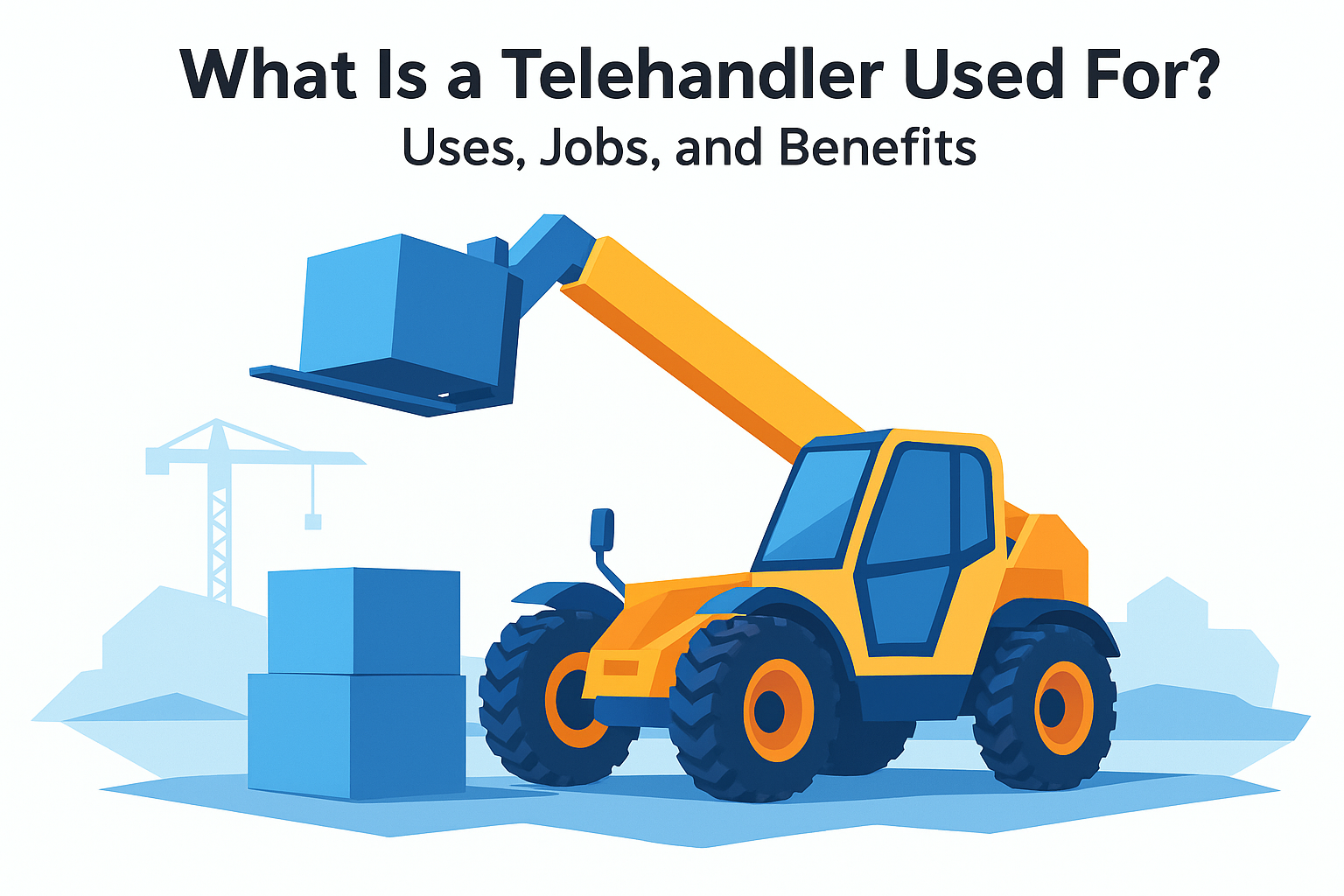
What Is a Telehandler Used For? Uses, Jobs, and Benefits
A telehandler is one of the most versatile machines on any job site, part forklift, part crane, and entirely its own category. The short answer to what it's used for: lifting, moving, and placing materials at heights and distances that standard equipment simply can't reach. From construction sites to agricultural operations, these machines handle jobs that would otherwise require multiple pieces of equipment.
JMT Editorial TeamPublished April 24, 20267 min read
In this guide
This article breaks down telehandler applications, the specific jobs they perform, and the practical benefits they offer, including how telehandlers compare to forklifts and cranes.
Why Telehandlers Matter on Modern Job Sites
Construction and agricultural operations increasingly demand equipment that does more with less. When you're managing a crew with limited machinery and tight budgets, every machine on your fleet needs to earn its place. A telehandler fills multiple roles in a single unit, replacing what would otherwise require a dedicated forklift, a mobile crane, and an elevated work platform all operating on the same site. That consolidation directly reduces operating costs and simplifies site logistics.
One Machine, Multiple Functions
The core mechanical advantage of a telehandler is its telescoping boom, which extends both forward and upward simultaneously. Unlike a standard forklift that only lifts vertically, a telehandler reaches out over obstacles, walls, and uneven terrain. This reach means you can place pallets on a rooftop, load a flatbed truck from a distance, or supply materials to an upper scaffold level without repositioning the machine between each task. The result is faster cycle times and fewer equipment moves per shift.
Your crew also spends significantly less time repositioning equipment when one machine handles multiple functions. On an active construction site, idle time between lifts costs money. A telehandler eliminates the wait for a crane crew to rig and set up, or a forklift driver to navigate tight corridors, because you're already in position and ready to move the next load.
Practical Advantages for Your Operation
Modern telehandlers are engineered with rough-terrain capability as a baseline requirement. Four-wheel drive and multi-mode steering allow these machines to travel across soft ground, loose gravel, and uneven surfaces where a standard warehouse forklift would stop completely. Cost efficiency is a major reason equipment buyers across emerging markets consistently prioritize telehandlers: acquiring a single versatile machine rather than two or three specialized units immediately reduces fuel consumption, operator headcount requirements, and maintenance overhead.
How a Telehandler Works and What It Can Lift
A telehandler operates using a telescoping boom mounted to the front of the machine, which extends both outward and upward in a single smooth motion. The operator controls the boom's angle and extension length from the cab, allowing precise placement of loads at height and distance simultaneously. Most machines also feature all-wheel steering with multiple modes, including crab steer and circle steer, giving them the maneuverability needed on congested or uneven sites.
Boom Reach and Load Capacity
The two core performance numbers to know are maximum lift height and rated load capacity. Compact telehandlers typically reach between 5 and 7 meters and lift 2,500 to 3,500 kg. Larger industrial models extend beyond 17 meters and handle loads exceeding 4,000 kg, though capacity drops as the boom extends further from the chassis. This relationship between reach and weight is called the load chart, and every machine comes with one that operators must follow to work safely — always consult it before attempting a lift at extended reach, because rated capacity at full extension is significantly lower than capacity at close range.
What Loads You Can Move
Telehandlers handle an enormous range of materials depending on the attachment fitted to the boom tip. Standard fork tines move palletized loads, cement bags, and building materials. Buckets shift loose aggregate, soil, and grain. Winch attachments allow you to lift suspended loads much like a crane would. Your actual lifting range depends on machine size, attachment type, and ground conditions.
What Telehandlers Are Used For by Industry
These machines appear across construction, agriculture, and industrial logistics because the same core capability, extended reach with rough-terrain mobility, solves different problems in each sector.
Construction
Construction crews use telehandlers to move building materials vertically and horizontally across active sites. Loading concrete blocks, roofing tiles, steel beams, and bagged cement to upper floors is a daily task that forklifts cannot handle because the materials land too far from the machine's reach. A telehandler with a 10-meter boom extension handles that job in a single smooth pass, keeping your crew supplied and on schedule without calling in a crane.
- Lifting scaffold materials to upper story levels
- Supplying roofing crews with tiles or metal sheeting
- Placing precast concrete panels with precision
Agriculture
Farmers and agribusiness operators use telehandlers to load, move, and stack heavy agricultural materials across large and often uneven properties. Hay bales, grain bags, fertilizer pallets, and silage are common loads. Agricultural telehandlers also handle tasks like loading trailers directly from field storage or filling elevated feeding systems.
Industrial and Port Logistics
Warehouses and port facilities use telehandlers for loading and unloading oversized cargo that standard forklifts cannot reach or stabilize. These environments demand machines that move heavy consolidated loads from truck beds, containers, and storage yards with precision.
Attachments and Sizing Tips for the Right Telehandler
Selecting the wrong attachment or machine size is one of the most common mistakes equipment buyers make. Attachments transform a telehandler from a single-purpose lift into a multi-role workhorse, and the right selection depends entirely on your most frequent task type. Most booms accept attachments through a quick-coupler system, so switching between jobs takes minutes rather than hours.
- Pallet forks: standard for construction material and bagged goods on flat sites
- Bucket: moves loose aggregate, sand, or grain in agricultural and civil work
- Winch: lifts suspended loads without rigid contact, useful for rigging operations
- Work platform: puts your crew at height safely for installation and maintenance tasks
- Bale clamp: grips round or square hay bales securely in agricultural settings
Choosing the Right Size
Your maximum lift height and load weight requirements determine the minimum machine specification you need. Match your boom reach to the tallest point your materials need to reach, then add at least 10% clearance for safety. Ground conditions also drive sizing decisions — soft or muddy terrain demands higher ground clearance and wider tires, which increases overall machine footprint.
Telehandler vs Forklift vs Crane vs Lift
Each machine does one or two things exceptionally well, but only the telehandler combines extended forward reach with rough-terrain mobility and quick attachment changes in a single unit. A standard forklift lifts heavy loads vertically in confined warehouse environments but cannot reach over obstacles or travel across loose ground without tipping or getting stuck. A tower crane handles extreme heights and massive loads on large construction sites, but setup takes hours, a licensed operator is required, and the machine stays anchored in one position. An elevated work platform (scissor lift or EWP) raises personnel safely but carries minimal load capacity and cannot move materials from one point to another.
- Telehandler — rough-terrain: yes, forward reach: yes, lift height: high, multi-attachment: yes
- Forklift — rough-terrain: no, forward reach: no, lift height: moderate, multi-attachment: limited
- Crane — rough-terrain: no, forward reach: yes, lift height: very high, multi-attachment: no
- Work platform — rough-terrain: limited, forward reach: no, lift height: high, multi-attachment: no
Your decision should start with your most demanding daily task, not the lowest purchase price. If that task requires moving loads across soft ground to elevated positions with multiple attachment types throughout the working day, the telehandler is the only machine that covers all of it without calling in additional equipment.
Final Takeaways
A telehandler earns its place on any fleet by combining extended reach, rough-terrain mobility, and attachment flexibility into one unit, replacing multiple specialized machines at a fraction of the combined cost. Choosing the right machine size and attachment set for your workload determines how much value you actually extract from this investment — start with your most demanding daily task, match the boom reach and capacity to that requirement, and build your attachment list from there.
Related guides
Still looking for the right machine?
Tell JMT what you need, or browse everything currently in stock.